
USA Jewelry Manufacturers vs Overseas: Which Is Better For Your Brand in 2026?
USA Jewelry Manufacturers vs Overseas: Which Is Better For Your Brand in 2026?
![[HERO] USA Jewelry Manufacturers vs Overseas: Which Is Better For Your Brand in 2026?](https://atila.com/wp-content/uploads/2026/02/Atila-Jewelry-Manufacturing-Gold-and-Diamonds.jpg "Atila | USA Jewelry Manufacturers vs Overseas: Which Is Better For Your Brand in 2026?")
Dear Reader,
If you're building or scaling a jewelry brand in 2026, you've likely hit this fork in the road: Do I manufacture in the USA or go overseas?
It's not a simple answer. Both options have real advantages. Both come with trade-offs. And the "right" choice depends entirely on where your brand is headed, what you value, and how you want to position yourself in an increasingly conscious market.
So let's break it down: clearly, honestly, and without the sales pitch.
THE 2026 LANDSCAPE: WHAT'S CHANGED
Here's the thing: the jewelry manufacturing world looks different than it did even two years ago.
Supply chain disruptions taught brands hard lessons about lead times and reliability. Tariffs reshaped cost structures. And consumer demand for transparency and ethical sourcing hit an all-time high: 78% of American consumers now check if diamonds are ethically sourced before making a purchase.
The industry is also seeing a shift toward nearshoring and hybrid models, where brands combine offshore cost advantages with domestic production for speed-sensitive or high-value pieces. The old binary choice of "USA vs. overseas" is evolving into something more nuanced.
But let's start with the fundamentals.
WHY USA JEWELRY MANUFACTURERS WIN ON SPEED AND CONTROL
FASTER TIME-TO-MARKET
When you work with a jewelry manufacturer in Los Angeles or another U.S. hub, you're typically looking at weeks, not months.
No ocean freight delays. No customs hold-ups. No wondering if your samples are stuck at a port halfway around the world. If you need to iterate on a design or respond to a trend quickly, domestic production gives you that agility.
This matters especially if you're launching seasonal collections, testing new designs with your audience, or responding to real-time market feedback. Speed wins in today's retail environment.
SUPERIOR QUALITY CONTROL AND COMMUNICATION
Let's be honest: Quality control is easier when you can visit the factory.
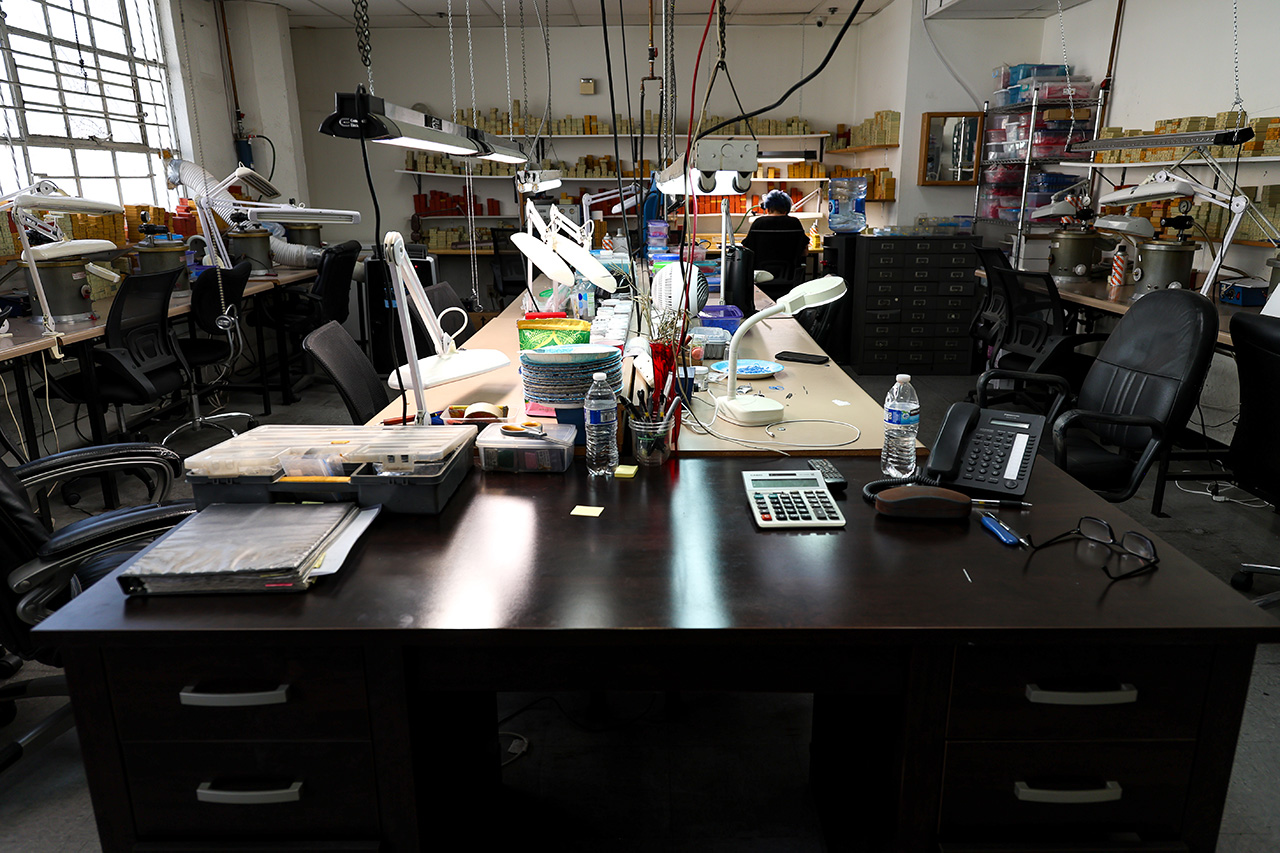
With USA jewelry manufacturers, you can schedule site visits, inspect prototypes in person, and build relationships with the people actually making your pieces. You're in the same time zone. You speak the same language. And if something needs adjusting, it happens in a conversation: not a 12-hour email lag.
At Atila, we've built our reputation on acting as an in-house extension of your brand. We don't just take orders. We collaborate on design, provide technical guidance, and maintain the kind of communication standards you'd expect from your own team. And when overseas manufacturing is the better fit, we can still keep you supported with clear specs, tight quality checkpoints, and consistent communication—so you’re not managing the process alone.
INTELLECTUAL PROPERTY PROTECTION
If your designs are proprietary: if they're what differentiates your brand: IP protection should be top of mind.
U.S. manufacturers operate under stricter legal frameworks. Design theft is easier to pursue legally. And frankly, the risk is just lower. You're not worrying about your sample designs showing up on Alibaba three months later.
THE "MADE IN USA" MARKETING ADVANTAGE
For certain customer segments, "Made in USA" isn't just a label: it's a value statement.
It signals ethical labor practices, environmental standards, and quality craftsmanship. In premium and luxury jewelry markets, it can justify higher price points and build brand loyalty. If your brand story includes sustainability or conscious production, domestic manufacturing gives you a powerful, verifiable claim.
WHEN OVERSEAS MANUFACTURING MAKES SENSE
That said, let's not pretend offshore production doesn't have legitimate advantages. It absolutely does.
COST EFFICIENCY AT VOLUME
Overseas manufacturing offers substantially lower production costs. Period.
If your business model requires high volumes at competitive price points: think fashion jewelry, mass-market accessories, or value-driven brands: the economics of offshore production are hard to beat. India, for example, handles $11.7 billion in U.S. jewelry imports and excels at diamond cutting, polishing, and large-scale manufacturing. Israel brings high-tech capabilities and diamond trading expertise.
These regions have built mature ecosystems specifically for jewelry production. They've invested in infrastructure, trained workforces, and supply chain efficiencies that can support massive order volumes.
SPECIALIZED EXPERTISE AND CAPACITY
Certain countries have developed deep expertise in specific processes: gemstone cutting in India, enameling in China, particular metalwork techniques in Thailand.
If your designs require highly specialized skills or ultra-high-volume capacity that U.S. manufacturers can't match, overseas production might be necessary. Just know what you're trading for that capacity.
KEY CONSIDERATIONS FOR YOUR BRAND IN 2026
So how do you actually decide? Here are the critical questions to ask yourself:
1. What's your brand positioning?
If you're building a luxury, premium, or conscious brand, USA manufacturers align better with your story. If you're competing primarily on price in the mass market, overseas production may be required.
2. How important is speed to market?
Do you need to respond to trends in weeks, or can you plan six months ahead? Domestic manufacturing gives you flexibility. Offshore requires longer planning cycles.
3. What's your order volume?
Custom jewelry manufacturers in the USA excel at jewelry manufacturing at scale for mid-to-high volume brands, but if you're ordering 50,000+ units per SKU, overseas capacity might be necessary.
4. How hands-on do you need to be?
If you want collaborative design support, regular communication, and the ability to visit your manufacturing partner, choose a jewelry manufacturer in Los Angeles or another U.S. hub. If you're comfortable with longer lead times and less direct oversight, offshore can work.
5. What are your ethical standards?
Your customers are asking. Be honest about what matters to your brand and whether you can verify labor practices, material sourcing, and environmental impact with your chosen partner.
THE HYBRID APPROACH: NEARSHORING AND STRATEGIC PARTNERSHIPS
More brands are adopting hybrid models in 2026.
They might manufacture high-value or trend-sensitive pieces domestically while producing staple items overseas. They might prototype in the USA with a partner like Atila, then scale certain styles offshore once designs are finalized.
There's no rule that says you have to choose only one path. The smartest brands are strategic about where each piece is made and why.
OUR TAKE: WHEN ATILA IS THE RIGHT PARTNER
Look, we're not going to tell you that every brand needs to manufacture in the USA. That wouldn't be honest, and it wouldn't serve you.
But if your brand values design differentiation, quality craftsmanship, speed to market, and collaborative partnerships, then working with custom jewelry manufacturers in the USA makes sense.
And if your brand needs overseas manufacturing for cost, capacity, or specialized processes? That can make perfect sense too. What matters is having a partner who can help you choose the right path (or a hybrid), lock in the details, and protect quality as you scale.
At Atila, we offer Los Angeles-based manufacturing and overseas manufacturing, and we help brands use either—or both—depending on what you’re building.
Specifically, our overseas capabilities are built to match different goals (volume, price point, or ultra-premium finishing):
- Indonesia: a massive 750+ person team built for large-scale production when you need serious capacity.
- Armenia: a high-end facility focused on super high-quality gold and silver work when details and finishing truly matter.
- Italy: large-scale chain manufacturing for brands that need consistent, repeatable chain production at scale.
So whether you’re keeping production close to home in Los Angeles, going overseas for volume, or building a hybrid supply chain, you’re not choosing between “two worlds.” You’re getting one versatile, global partner.
We handle everything from design and prototyping to full production runs, ecoating, and fulfillment. We work with emerging brands launching their first collection and established labels expanding their lines.
And we do it with the kind of communication, transparency, and attention to detail that you'd expect from an in-house team.
FINAL THOUGHTS
The choice between USA and overseas jewelry manufacturing isn't about right or wrong. It's about alignment.
What does your brand stand for? What do your customers care about? What are your actual constraints: budget, timeline, volume, quality standards?
Answer those questions honestly, and the path forward becomes clearer.
If you're ready to explore what's possible with a Los Angeles-based manufacturing partner who prioritizes quality, speed, and collaboration, let's talk. We're here to help you bring your vision to life: whether that's your first collection or your next phase of growth.
Cheers,
Atila Team

LET’S TALK ABOUTYOUR PROJECT
Schedule a 30-minute consultation to discuss your goals and learn more about how we can help bring your vision to life.
Jewelry has the power to be the one little thing that makes you feel unique.
— ELIZABETH TAYLOR